People email me this question more than any other, so here’s the honest version, with real numbers from around the industry. So what does a Dolby Atmos mix cost? Between $350 and $750 a song at most professional studios, with good reasons for the spread. I mix Dolby Atmos for a living at Sonic Forest Studios on Vancouver Island, and I quote every project individually, but you deserve to know the going rates before you talk to anyone.
The short answer
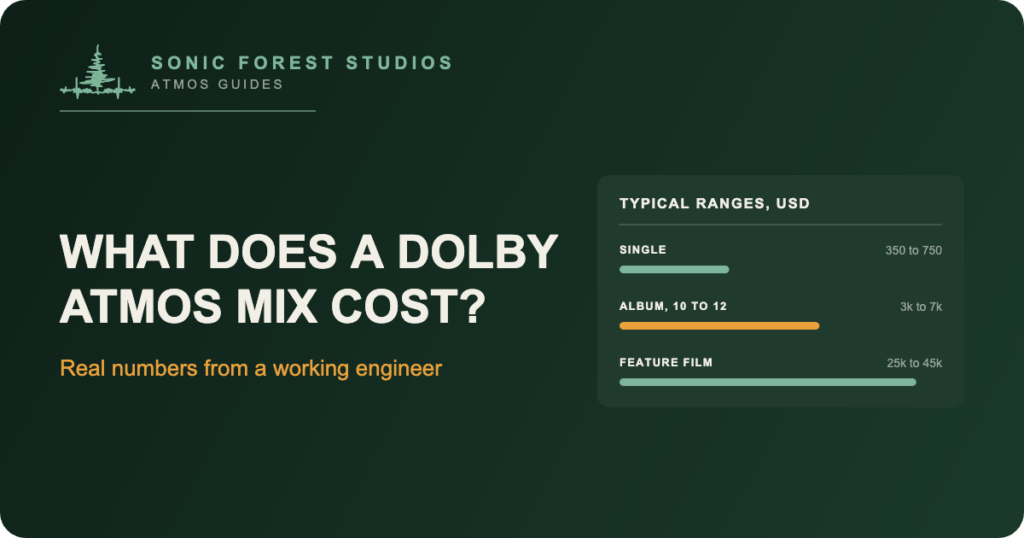
For a single song, most professional studios charge somewhere between $350 and $750 USD for a Dolby Atmos mix. Budget online services run $200 to $350. Big-name rooms with famous credits charge more, sometimes a lot more. Albums usually land between $3,000 and $7,000 for ten to twelve tracks, because most engineers discount per-track pricing when they can mix the whole record in one focused block.
Film is its own world. A feature-length Atmos mix at a mid-tier Los Angeles stage runs $25,000 to $45,000 with all deliverables, and the top rooms go past $70,000. Those numbers buy you a stage, a lot of overhead, and a calendar you’re sharing with three other productions. A certified room outside the big markets delivers to the same spec, and what changes is who’s sitting at the desk: the engineer you actually talked to, for the whole job, start to finish. Some productions want the stage. Some want the engineer. Worth knowing which one you’re paying for.
Don’t take my word for any of this, go look. One popular online service lists $300 to $540 a song. Another posts a flat $350 for Atmos alone, or $500 for a stereo-plus-Atmos bundle with five revisions and a five-day turnaround. A US studio doing a lot of hip hop work charges $699 a song for a mixtape-style session and $899 for a full multitrack mix, with a discount if you bring two. Those are real published rates as of July 2026, and they cluster right about where I said.
What you’re actually buying
Here’s what nobody tells you: “an Atmos mix” isn’t one file.
What leaves my room is an ADM BWF master for the streaming services, plus 7.1 and 5.1 versions, plus a binaural headphone mix, all sitting at -18 LUFS because that’s the standard Dolby and Universal landed on. Then a QC pass, so the ADM re-imports clean and its length matches your stereo master, since that’s the thing that bounces releases back from distributors.
If a quote doesn’t spell out which of those you get, ask. The gap between “we’ll make you an Atmos file” and “here’s a delivery-ready package” is most of the price spread in this industry, and you can’t hear the difference until a distributor says no.
One more thing worth saying out loud. I need your mastered stereo mix too, and not because I’m fussy. It’s my reference. The Atmos version has to feel like the record you already signed off on.
What actually drives the price
Track count and runtime, first. A 40-channel indie session and a 200-track pop production are different jobs. Second, the state of your stems: clean, labeled, consistent start points save hours. Third, revisions, so ask what’s included before comparing quotes. And fourth, the room itself, which is the part people underestimate.
On track count, the jump isn’t linear. Doubling your tracks doesn’t double my time. But going from 40 to 200 changes how the session gets organized, what becomes an object versus what lives in the bed, and how long the automation passes take. That’s where the hours actually go.
On stems, this is the one you control, and it’s worth real money to you. Files that show up at the wrong sample rate, or with processing sitting on a mix bus instead of printed into the stems, or named “audio 07,” turn a clean day into a day and a half. I wrote the whole checklist out in how to prepare your stems for a Dolby Atmos mix. Ten minutes on your end moves the number I quote.
On revisions, two studios quoting $400 aren’t quoting the same thing if one includes two rounds and the other includes five. Ask. It’s the single most common place where quotes quietly stop being comparable.
On the room, an Atmos mix made on headphones with an upmixer and an Atmos mix made in a calibrated 7.1.4 room are different products that happen to share a file extension. You’re paying for the speakers, the treatment, and the fact that what I’m hearing is close to what a listener’s system will rebuild.
And a fifth one I’d add: deadlines. Normal turnaround is a few days a song. If you need it Thursday because the distributor moved on you, that’s a rush, and every studio prices rush differently.
One song, an EP, or a whole album
Per-song pricing is the worst deal in immersive audio, and almost nobody says so out loud.
When I mix a record as one block, I build the template once, learn the artist’s habits once, and carry a decision from track three into track nine. That efficiency is real, and it should show up on your invoice. Ten to twelve tracks landing between $3,000 and $7,000 works out to roughly $250 to $600 a song, which is under the singles rate almost everywhere.
So if an album is coming, say so up front. The number changes, and not in a way that hurts you.
Film, TV, and long form is a different market
Music pricing doesn’t transfer here. Feature work gets quoted in mix days, not songs, usually six to eight days for a feature at roughly $2,500 to $3,500 a day.
One 2026 industry cost guide breaks the regions down like this: top-tier Los Angeles at $40,000 to $70,000, mid-tier LA at $25,000 to $45,000, UK and Canadian facilities around $30,000 to $55,000, and Korea and Eastern Europe well under that at $12,000 to $32,000 depending where you look. Hour-long episodic sits near $8,000 to $18,000 an episode in LA. Treat those as a map, not a quote.
I mixed a 90-minute feature called Colorblind in Atmos, so let me say the quiet part. The money in film isn’t really the mixing. It’s the deliverables and the revision cycles. Broadcast timecode, a defined first frame of action, reel lengths that match picture to the frame, and a post supervisor who needs three versions by Friday. Get the delivery spec in writing before anyone quotes anything, including me.
The cheap Atmos mix problem
Plenty of “finished” Atmos masters get rejected by distributors for loudness and metadata problems, and plenty more technically pass but sound like a gimmick because they were made with an upmixer plugin on headphones instead of mixed from stems in a calibrated room. If a price looks too good to be true, ask what room it was mixed in and whether QC is included. A rejected master costs you the cheap fee plus the redo.
And I’m not exaggerating about the low end. There are freelance listings up right now offering an Atmos mix and master, up to 25 stems, for $75. Do the arithmetic. Nobody is spending a working day in a treated room for $75. What you’re buying there is a plugin pass and optimism.
The math on a rejection is worse than it first looks, too. Say you paid $150 and it comes back. Now you’re paying someone else $500 to do it properly, you’ve already eaten the first fee, and your release date has moved. That whole cost lands on you, not on the person who took the $150.
What I’d ask before hiring anyone
Steal this list. Use it on me.
- What room is it mixed in, and is it Dolby certified?
- What exactly do I receive? Does that include the ADM BWF and a binaural reference?
- Is QC included, or extra?
- How many revisions, and what counts as one?
- What do you need from me, and in what format?
- Who actually does the work?
That last one matters more than people expect. The name on the website isn’t always the person at the desk.
Common questions
Is a Dolby Atmos mix worth it for an independent artist?
Sometimes. If you’re releasing to Apple Music and you want a shot at playlist consideration, it helps, and the format is still uncrowded enough that a good Atmos mix stands out. But if you’ve got one song and a thin budget, put it into the stereo mix first. A great stereo record beats a mediocre Atmos one every single time.
Can I just upmix my stereo master instead?
You can. It’ll sound like an upmix. The tools have improved and I’ve heard one or two that were fine for background listening, but anyone paying attention hears it, and it gives up the whole point of the format. Mixing from stems is the actual job. More on why in stereo vs Atmos, what artists actually need to know.
Do I have to pay for a separate stereo master too?
No, but I need yours, as a reference. If you don’t have one yet, that’s a separate conversation and a separate line on the quote.
How long does an Atmos mix take?
For music, figure two to five business days a song depending on the queue and how complicated the session is. Albums get scheduled as a block, which is part of why they price better.
What does Atmos mastering cost compared to mixing?
Less, because it’s a shorter job. If you already have an Atmos mix that needs checking, correcting, and getting to spec, that’s Dolby Atmos mastering and it’s quoted separately.
Is spatial audio the same thing as Dolby Atmos?
Close enough to confuse everybody. Apple’s “Spatial Audio” is mostly Atmos content played back through Apple’s own renderer. The delivery target is the same either way, and Apple publishes the specs I mix to in their music delivery spec.
Why I quote per project instead of posting a rate card
Because a three-song EP from clean stems and a 14-track album with restoration work are not the same product, and pretending they are means someone overpays. Tell me your track count and what you’re after, and you’ll have a real number in your inbox within 24 hours, usually same day. No obligation. The quote comes from the engineer who’ll actually mix your record in Dolby Atmos, in a certified 7.1.4 room designed with Dolby’s own engineers.
Curious what the Apple side calls all this? Same technology, different label: here’s how spatial audio mixing works. And if you already have an Atmos mix that needs checking before release, that’s a Dolby Atmos mastering job.
Update, September 2026. Since I first published this in July, I’ve added a few guides that answer the follow-up questions people usually send after reading this one: what an ADM BWF actually is, what Apple Music requires for spatial audio, and why your Atmos mix might sound quiet next to the stereo. And if you’d rather skip the popup, the contact page has the same quote form.
Todd Hooge is the founder of Sonic Forest Studios in Victoria, BC, the first fully functional Dolby Atmos studio on Vancouver Island. His Atmos work spans over 456 million streams, including Marianas Trench’s Haven and Elijah Woods’ “look what i made.”