Every week an artist asks me whether Atmos is worth it or just another format the industry will forget. Fair question. I mix both stereo and Dolby Atmos every day, so here’s the difference in plain language, and when each one earns its keep.
The short version of stereo vs Atmos: stereo is the two-channel mix every platform on earth still requires, and Atmos is a three-dimensional mix that ships alongside it, earns extra promotion and royalty attention on the platforms that support it, and folds down cleanly for whatever the listener owns. You don’t pick one. You release both, and the real questions are about order, budget, and timing. That’s what the rest of this covers.
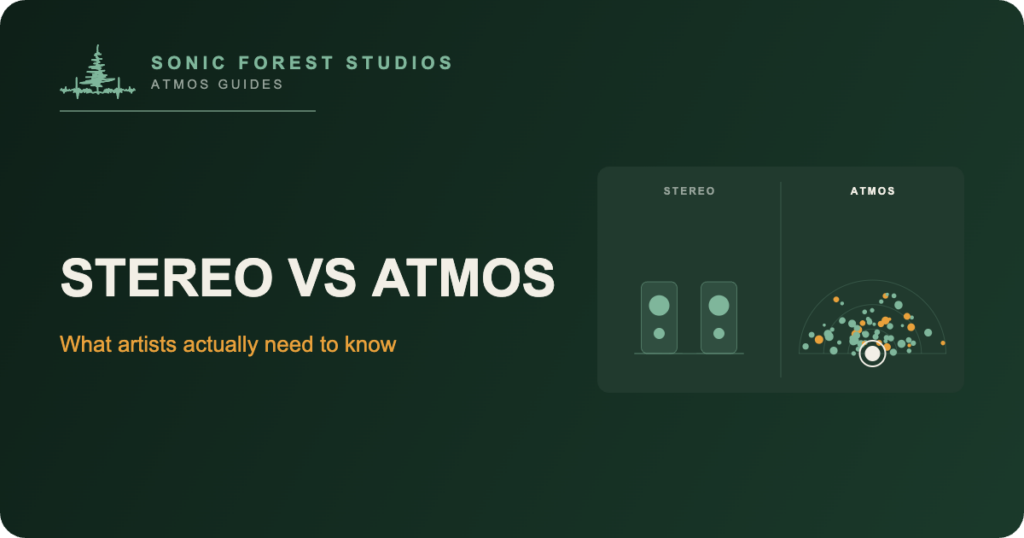
Stereo is two speakers. Atmos is a space.
A stereo mix places everything on a line between two speakers. An Atmos mix places every instrument in a three-dimensional field: width, depth, and height. Done well, vocals sit right in front of you and reverbs breathe overhead. Done badly, it sounds like your song fell into a swimming pool. The difference is whether it was genuinely mixed from stems or just run through an upmixer.
Under the hood, an Atmos mix is a bed of channels plus up to 118 objects, individual sounds that each carry their own position data, 128 audio elements in total. The playback system decides how to render them: a full speaker array uses the ceiling, a soundbar approximates it, and headphones get a binaural render that builds the space between your ears. That last one matters most, because headphones are where most of your listeners actually live.
| Feature | Stereo mix | Dolby Atmos mix |
|---|---|---|
| Channels | Two, left and right | A bed of channels plus up to 118 objects, 128 audio elements in total |
| Where sounds sit | On a line between two speakers | Anywhere in a field: width, depth and height |
| Playback | Every device ever made | Speaker arrays use the ceiling, soundbars approximate it, headphones get a binaural render |
| Deliverable | Stereo WAV master | ADM BWF, one WAV carrying the mix plus position data, synced to the stereo master |
| Loudness | Modern masters push -8 to -9 LUFS | About -18 LUFS integrated, then the platforms normalize |
| Where it streams | Everywhere | Apple Music, Tidal and Amazon Music |
| Do you need it | Still required by every platform | Released alongside stereo, never instead of it |
What actually changes when I mix in Atmos
So what do I do differently in the chair? Panning becomes placement. Instead of nudging a guitar 30% left, I can set it just behind your shoulder and let it hold that spot. Reverbs and delays get real space of their own, which means dense arrangements stop fighting for the same crowded lane. I can keep a lead vocal dry and close while the background vocals bloom overhead, something a stereo bus makes you fake with EQ carve-outs and level games.
The stereo mix stays the reference through all of it. When I mixed Marianas Trench’s Haven in Atmos, the job was never to reinvent the songs. It was to take arrangements that were already packed tight and give every part its own address. Same record, same intent, more room to breathe.
Why platforms care
Apple Music actively promotes Spatial Audio releases and pays attention to catalogs that support it. Tidal and Amazon Music stream Atmos too. Playlist editors increasingly favor it, and the listening hardware is already everywhere: every AirPod, most new cars, soundbars, and phones. Your listeners have the gear whether you feed it or not.
There’s a money reason underneath the promotion, too. In January 2024, Apple started paying up to 10% higher royalties on music available in Spatial Audio, and Spatial playback has been the default on Apple Music since 2021. I made the longer argument about where this is heading in why immersive audio is the next stereo, so I’ll keep it short here: follow the incentives.
The cost question, briefly
Atmos is a separate mix, so it’s a separate line item, and pretending otherwise helps nobody. The full numbers, including what pushes a quote up or down, are in what does a Dolby Atmos mix cost. The one thing worth repeating: mixing stereo and Atmos from the same session in the same room costs less than adding Atmos somewhere else later, because the setup work happens once and the two mixes share one set of decisions.
What stays the same
Your stereo mix still matters. Streaming services switch between your stereo and Atmos files depending on the listener’s setup, so the two versions need to feel like the same record. That’s why I mix both from the same session when a project calls for it: one sonic identity, two formats.
Loudness is the other constant that trips people. An Atmos master delivers much quieter than a modern stereo master, -18 LUFS integrated against the -8s and -9s stereo records push, and the platforms level everything with normalization anyway. So when your Atmos file meters lower than your stereo file, nothing is broken. It’s following the spec, and the spec is doing your dynamics a favor.
When stereo-only is fine
Demos, quick releases, and tight budgets: stereo first, always. Atmos rewards songs with space in the arrangement and records you plan to promote. If you’re choosing between a great stereo mix and a rushed Atmos mix, take the stereo mix. The good news: you can always add Atmos later, because it builds from stems you already have. That goes for back catalog too.
If later ever comes, the prep is mostly stems: wet, labeled, at the session’s real sample rate, with the mastered stereo as the sync reference. I keep a whole guide on that in how to prepare your stems for an Atmos mix, and it will save you a week of back-and-forth. The songs you released five years ago are closer to an Atmos version than you think, provided the session files still exist.
How the Atmos version actually gets delivered
The deliverable is a file called an ADM BWF, one big WAV that carries every element of the mix plus its position data, synced to your stereo master so platforms can flip between the two. Your distributor sends it up the chain; you never upload to Apple yourself. And no, nobody reputable makes that file by running a stereo master through an upmixer. Apple rejects those, and they should. I took the file apart, gently, in ADM BWF explained.
Hearing it for yourself beats reading about it
Send me a track and I’ll show you what it sounds like in three dimensions, with a binaural render you can hear on whatever headphones you own. Details on the full service are on the Dolby Atmos mixing page, the Apple-flavored version lives on the spatial audio mixing page, and quotes take about a day.
Stereo vs Atmos: quick answers
Do I have to choose between a stereo mix and an Atmos mix?
No. Every release that has an Atmos version also ships a stereo version, and the streaming services decide which one plays based on the listener’s device and settings. Stereo remains mandatory everywhere. Atmos is the addition, not the replacement. The choice you’re actually making is whether the Atmos version exists at all, and that’s a budget and promotion call, not a technical fork.
Is an Atmos mix just my stereo mix with extra effects?
No. A real Atmos mix is rebuilt from your stems, with every instrument placed as an object in three-dimensional space. An upmixer that inflates a finished stereo file into fake surround is a different product entirely, and Apple Music rejects Atmos files generated from stereo masters. If someone quotes you a suspiciously cheap Atmos conversion and never asks for stems, now you know what they’re selling.
What do listeners without Atmos gear hear?
Most of them hear the Atmos mix anyway, just folded down. On Apple Music, ordinary headphones get a binaural render of the Atmos version by default, no special hardware involved. Listeners on platforms that don’t carry Atmos, or with Spatial switched off, get your stereo mix. Nobody hears silence or a broken file; there’s always a version to fall back on. That fallback chain is exactly why the two mixes need to feel like one record.
Does a stereo vs Atmos release cost double?
No, but Atmos is a real second mix, so expect a real second line item. It often lands well under double when both mixes happen in the same room from the same prepped session, because setup, revisions, and QC overlap. The actual numbers are in my cost article linked above, and back catalog often batches cheaper per song.
Can I add an Atmos mix to music I already released?
Yes, and catalog work is some of my favorite mixing. The Atmos version builds from stems you already have, nothing gets re-recorded, and your distributor attaches the new file to the existing release. Labels are converting whole catalogs right now because the Spatial royalty uplift applies to old songs the moment they’re available in the format. One practical note: finding the original session files is usually the hardest part, so start that archaeology early.
Which platforms stream Atmos music right now?
Apple Music, Amazon Music, and Tidal all stream Dolby Atmos today, with Apple pushing hardest through Spatial Audio promotion and royalty incentives. Spotify doesn’t stream Atmos as of this writing, so your stereo mix carries that platform. The install base tilts toward Apple regardless: AirPods alone put spatial playback into hundreds of millions of pockets, and most new cars and soundbars decode it natively.
Todd Hooge is the founder of Sonic Forest Studios in Victoria, BC, and mixes stereo and Dolby Atmos records side by side every week. His Atmos work, including Marianas Trench’s Haven, has passed 456 million verified streams.