An ADM BWF is a single WAV file that carries your entire Dolby Atmos mix: the bed, every object, and the metadata that tells a playback system where each sound sits in the room. The name stands for Audio Definition Model Broadcast Wave Format. It’s the master file for Atmos music, and it’s what Apple Music, Amazon Music, and Tidal expect your distributor to hand over. Getting that file to pass every platform’s specs first time is its own craft, which is exactly what Dolby Atmos mastering and QC is for. One file, everything inside.
That’s the short answer. If you take nothing else from this page, take that: your Atmos release doesn’t ship as a stereo-style bounce or a folder of stems. It ships as an ADM BWF, and if that file has a problem, your release has a problem.
Now the longer answer, because this file is stranger and more interesting than it sounds.
So what’s actually in there?
Think of an ADM BWF as a moving truck rather than a photograph. A stereo master is a photograph: two channels, fixed, done. An ADM BWF instead packs up all the pieces of your mix and the instructions for where everything goes, so the room on the other end can unpack it however it’s built.
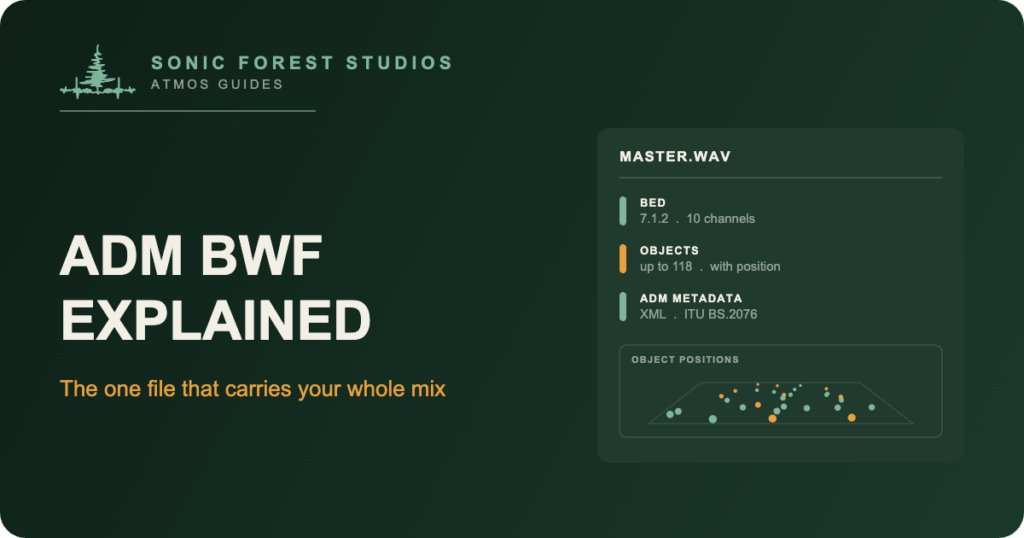
Inside the file you’ve got the bed, which is the fixed channel layout underneath everything (usually 7.1.2, ten channels). Then the objects: individual sounds, up to 118 of them, each with metadata describing its position in three-dimensional space over time. That lead vocal I automated to drift up and back during the bridge? The file doesn’t store “vocal in left rear speaker.” It stores the vocal audio plus coordinates, moment by moment. Add it up and Atmos gives you 128 audio elements to work with.
All of that metadata rides inside the WAV itself as a block of XML defined by the Audio Definition Model, an open standard published by the ITU as BS.2076. So the “ADM” part is the instructions and the “BWF” part is the truck. Broadcast Wave Format, a WAV that’s allowed to carry paperwork.
These files get big. A three and a half minute song often lands north of a gigabyte. When I delivered a full album’s worth of Atmos mixes for the first time, the upload took longer than some of the mix sessions. I’ve made my peace with that. Mostly.
Why streaming services want instructions, not speakers
Here’s the part that clicked for me early on and made me a believer. Nobody who streams your song hears the ADM BWF directly. Apple runs it through its own spatial renderer for headphones. A soundbar folds it down one way, a full 7.1.4 home theatre another way, a car with an Atmos system yet another. Same file, different rooms, and the renderer rebuilds the mix for whatever’s actually there.
That’s only possible because the file carries positions instead of baked-in speaker feeds. And it’s the whole reason I keep saying immersive is the next stereo: the format finally separates the mix from the playback system. If you’re still fuzzy on what separates an Atmos mix from a stereo one in the first place, I broke that down in Stereo vs Atmos: What Artists Actually Need to Know.
Is the renderer always right? Honestly, not always. Binaural on headphones involves some compromise, and I check every mix against it before delivery. But the trade is worth it.
ADM BWF vs the other files on the export menu
The Dolby tools will happily produce several things that are not an ADM BWF, and mixing them up is a classic way to fail a delivery.
The DAMF, or Dolby Atmos Master File, is a set of three files (.atmos, .atmos.metadata, .atmos.audio) that the Dolby Atmos Renderer uses as its native master. It’s great for archiving and for moving sessions between studios. Distributors generally don’t want it.
The MP4 with Dolby Digital Plus JOC is the compressed consumer stream, the thing that actually plays on your phone. You don’t deliver this; the streaming services encode it themselves from your ADM.
The binaural bounce is just a stereo render of the headphone fold-down. Useful for sending a client a quick reference at midnight. Useless as a deliverable.
The ADM BWF is the one your distributor means when they say “send the Atmos master.” When in doubt, it’s this one.
The numbers that matter
The delivery spec for Atmos music is stricter than most people expect, and the streaming services do check. The Apple Music specs are the ones I mix to, since they’re the strictest of the bunch. The short version: 48 kHz, 24-bit. Integrated loudness at or under -18 LUFS, measured on a re-render of the master, with true peak at or under -1 dBTP. First frame of audio where it belongs, no stray silence, and the file length matching your stereo master so the two versions stay in sync on the service.
That -18 LUFS number surprises people coming from stereo, where masters routinely slam -8 or louder. Atmos runs quieter on purpose, and the platforms normalize playback anyway. I wrote about what that means for your wallet, so to speak, in What Does a Dolby Atmos Mix Cost, and I’ve got a whole post coming on why Atmos mixes feel quiet. The one-line version: stop chasing loudness, the renderer has already taken that game away, and thank goodness.
A quick note if you’re in film or post
Music is only half the story. Long-form ADM BWF delivery, the kind I did for the feature film Colorblind, adds its own layer: broadcast timecode, a defined first frame of action, and reel or program lengths that have to match picture to the frame. The file format is the same truck, but the paperwork gets stricter, and a two-hour film’s master is a genuinely huge file. If your project is a film or a series episode rather than a song, the delivery spec comes from the studio or platform’s post team, not from the music specs above. Ask for it early. I’ve watched productions lose days at the finish line because nobody requested the delivery spec until the mix was done.
Where ADM files go wrong
I QC every ADM that leaves this studio, and I’ve seen the same failures over and over. Wrong sample rate, usually 44.1 kHz sneaking in from a music session. Loudness over the -18 LUFS ceiling, or true peaks over -1 dBTP that only show up on the re-render. Missing or broken metadata, which can happen when a file gets exported from one tool and re-wrapped by another. Stray audio before the downbeat. A file that doesn’t match the stereo master’s length, which causes real problems when a service tries to switch between versions mid-play.
None of these are exotic. All of them will bounce a release back from QC, and the bounce usually shows up right when you’re trying to lock a release date. The fix is almost always cheap if you catch it before delivery and expensive if you catch it after.
Check the file before it ships
If you’re mixing Atmos yourself, open your ADM BWF in the Dolby Atmos Renderer and confirm it re-imports clean, then measure loudness on the re-render, not on your monitor path. If the numbers and the metadata both check out, you’re most of the way there.
And if you’d rather have a second set of ears on it, that’s a big part of what I do at Sonic Forest Studios. I’ve delivered ADM BWFs for everything from Marianas Trench’s Haven to a 90-minute feature film, and the QC pass is the same discipline every time, whether I mixed the record or you did.
Your Atmos mix might be brilliant. But the streaming services will never hear your mix, only your file. Is the file right?
ADM BWF quick answers
Can I export an ADM BWF from a stereo mix?
No. An ADM BWF has to come from a real multichannel Atmos session, because the file stores every element’s audio and its position separately. Run a stereo master through an upmixer and you get something that technically opens but fails the point of the format, and Apple Music explicitly rejects Atmos files generated from stereo sources. If a stereo master is all you have, the honest path is a remix from your multitracks. Slower, yes. Also the only version worth your money.
What software opens an ADM BWF?
The Dolby Atmos Renderer is the reference, and it’s what I use for the final QC pass on every file that leaves this studio. Current versions of Logic Pro, Nuendo, and Pro Tools can import an ADM BWF straight into a session, which matters when a label hands you someone else’s master to revise. An ordinary audio player is no help here. It can’t read the positional metadata, and that metadata is the whole reason the file exists.
How big is an ADM BWF file?
Big. A single song usually lands in the hundreds of megabytes, and a dense mix can pass a gigabyte, because the file can carry up to 128 elements of uncompressed 24-bit audio plus position data for each one. So don’t panic when one single outweighs your whole stereo album. That’s normal. Send it through a real transfer service with a checksum, not email, and keep a copy of exactly what you delivered.
Do I send the ADM BWF to Apple Music myself?
Not directly. Your distributor delivers the ADM BWF alongside your stereo master, and the platforms run their QC once it arrives. Two catches worth knowing. Not every distributor accepts Atmos files, so confirm yours does before you book the mix. And a rejection travels back through that same slow pipeline, which is why I measure everything before it ships. The QC gauntlet only hurts when you meet it unprepared.
Is the ADM BWF the same thing as my stereo master?
No, they’re separate deliverables that travel together. Your stereo master is two channels, finished loud, still the version radio, DJs, and sync licensing run on. The ADM BWF is the Atmos master: multichannel, quieter by spec at -18 LUFS, and synced to the stereo file so streaming services can switch between the two cleanly. Every Atmos release still ships with a stereo master. That file isn’t going anywhere.
Can you check an ADM BWF I made myself?
Yes. That’s a standing service at Sonic Forest Studios, built for exactly this moment of doubt. You send the file, I re-import it in the Renderer, measure integrated loudness and true peak on the re-render, listen through the binaural, and tell you whether it’ll clear delivery before your distributor ever sees it. Checking a file takes under an hour. Re-delivering a rejected album takes weeks. Details live on the Dolby Atmos mixing page.
Todd Hooge is the founder of Sonic Forest Studios in Victoria, BC, the first fully functional Dolby Atmos studio on Vancouver Island. His Atmos work spans over 454 million streams, including Marianas Trench’s Haven and Elijah Woods’ “look what i made.”