Ever had a distributor bounce an Atmos master with a one-line note that says “loudness out of spec”? That note almost always traces back to Apple. So let’s get the actual numbers on the table before they cost you a release date.
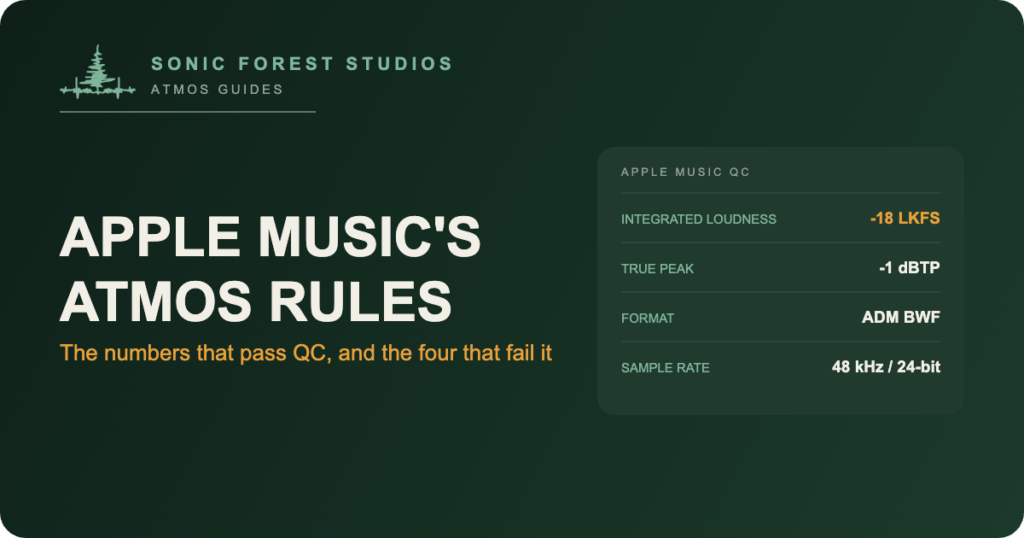
The Apple Music spatial audio requirements fit in one paragraph. Your Dolby Atmos master goes in as a BWF ADM file at 48 kHz, 24-bit. Integrated loudness can’t exceed -18 LKFS, measured to ITU-R BS.1770-4, on every individual track. True peak stays under -1 dBTP. Upmixes built from a stereo file aren’t allowed at all. And the Atmos version has to line up with the stereo master of the same song, within about half a video frame if the album plays gapless. Miss any one of those and QC sends it back.
That’s the whole spec. The rest of this article is what those numbers feel like in the mixing chair, and the four mistakes that cause most rejections.
Why Apple’s spec is the one everyone mixes to
Apple Music isn’t the only place spatial mixes live. Amazon Music and Tidal both carry Atmos, and their specs are close cousins. But Apple published theirs in detail in the Video and Audio Asset Guide, and they enforce them. Real QC, not a checkbox. So when I mix Atmos here at Sonic Forest Studios, Apple’s numbers are the floor. Pass Apple and you’ve passed everybody.
One more reason it matters: rejections cost you time you don’t have. A bounced master goes back through your distributor’s queue, and that can add a week or two to a single. If your release Friday is locked and your playlist pitch is in, that’s a real problem, not a paperwork problem.
The -18 LKFS loudness ceiling
This is the number that surprises people coming from stereo. Apple caps integrated loudness at -18 LKFS, measured over the full length of the track using ITU-R BS.1770-4. Not short-term, not momentary. The whole song, averaged.
Two details trip people up. First, it’s measured per track, not per album. You can’t hide one hot song inside a quiet record. Second, -18 LKFS is a ceiling, not a target. A ballad that lands at -20 is fine. A club track slammed to -14 is not, and no, it won’t get a pass because the genre expects it.
Here’s the part I actually like. After twenty years of the stereo loudness war, -18 gives your mix room to breathe. Choruses can get louder than verses again. Drum transients survive. When I mixed at these levels for the first time, the instinct to limit everything took a while to die, and I guess it never fully does. But the mixes are better for it. Dynamics are the reason spatial audio sounds expensive.
True peak: -1 dBTP, no exceptions
Alongside the loudness ceiling, every deliverable has to keep true peak at or below -1 dBTP, same BS.1770-4 measurement. True peak, not sample peak. Intersample overs that a regular meter misses will still fail you.
And one guideline that’s easy to overlook: Apple recommends the limiting indicated for the binaural headphone render stay within about 3 dB. Most listeners hear your Atmos mix on AirPods, not on a 7.1.4 rig. If your bed and objects are hitting the binaural renderer hard enough to need more than that, the headphone version is already suffering, and that’s the version that matters commercially.
The file itself: ADM BWF, 48 kHz, 24-bit
Apple takes music Atmos as a Broadcast Wave Format file with an Audio Definition Model header, 24-bit at 48 kHz. If you want the full anatomy of that file, I wrote up what an ADM BWF actually contains and why it’s the one file that runs your whole release.
A couple of quieter rules live here too. Full-frequency content doesn’t belong in the LFE channel; the LFE is for low end, and Apple checks. And your source has to be a real spatial mix built from multitracks or stems. Files generated by upmixing a stereo master are explicitly not allowed. There’s software that claims to do this convincingly. Apple’s QC has heard all of it.
If you’re getting stems together for a mix like this, my guide on preparing stems for an Atmos mix covers the sample rate, length, and labelling details that make the session go fast.
The sync rule nobody reads until it bites
Your Atmos master doesn’t exist alone. Apple requires it to conform and sync to the stereo master of the same track. On a gapless album, the track boundaries have to land within 1,000 samples at 48 kHz of the stereo version’s boundaries. That’s about half a video frame. Twenty milliseconds.
Sounds easy. It isn’t, once real life gets involved. The stereo master got a new head trim at mastering. Somebody added a breath of silence to the top of track one. The Atmos session started from an earlier bounce. Any of those and your album crossfades now hiccup between formats, and QC will catch it even when you don’t.
What actually gets rejected
Nearly every bounced Atmos delivery I’ve seen or heard about comes down to one of four things. A master that’s too loud, because someone mixed to stereo instincts. A true peak over -1, usually intersample. An upmix wearing a spatial costume. Or an Atmos file that drifted out of sync with its stereo twin somewhere between mastering revisions.
Notice what’s not on that list: creative choices. Apple doesn’t reject mixes for being too wide, too subtle, or too weird. The spec is technical, which means passing it is a checklist, not a matter of taste. That should be reassuring. The rules are knowable and the failures are preventable.
How I check a mix against the spatial audio requirements before it ships
Every Atmos mix that leaves this studio gets measured before delivery: integrated loudness and true peak on the master, a listen through the binaural render at the limiting stage, an LFE check, and a sync comparison against the stereo reference. It takes under an hour and it has saved clients from every one of the four rejections above.
If you’re releasing spatial audio and want the mix done to spec the first time, that’s the job of my Dolby Atmos mixing service. And if you’ve already got a mix and just aren’t sure it will pass, get in touch through the same page. Checking a file is quick. Re-delivering an album is not.
Apple Music spatial audio requirements: quick answers
Does Apple Music reject mixes louder than -18 LKFS?
Yes. Integrated loudness above -18 LKFS, measured per BS.1770-4 over the full track, fails QC. It’s a ceiling, so quieter is fine.
Can I upmix my stereo master to Atmos?
No. Apple explicitly disallows Atmos files generated from stereo mixes. The mix has to come from multitracks or stems.
What file format does Apple Music want for spatial audio?
A BWF ADM file, 24-bit, 48 kHz. One file per track, synced to the stereo master.
Do Amazon Music and Tidal use the same requirements?
They’re very close. Mix to Apple’s spec and you’ll clear the others. The -18 LKFS and -1 dBTP pair is the common core.
Will -18 LKFS make my song sound quiet next to stereo releases?
No, because Apple normalizes playback loudness anyway. Your listeners hear everything levelled. What they’ll notice is the extra dynamics your mix kept.
Who checks my mix against the requirements?
Your distributor runs Apple’s QC gauntlet on your behalf, but by then a failure costs you calendar time. Measure before delivery, or have your mixer do it as part of the job.
Todd Hooge is the founder of Sonic Forest Studios in Victoria, BC, the first Dolby Atmos mixing studio on Vancouver Island. His Atmos work spans Marianas Trench’s Haven, Elijah Woods’ “look what i made”, and the feature film Colorblind, with over 454 million streams across projects he’s mixed. More on how Apple presents spatial audio to listeners is on Apple’s own explainer.