No. You don’t need a certified Dolby Atmos studio to release music in Atmos. Any room running the Dolby Renderer can export a valid ADM BWF, and every platform from Apple Music to Tidal will take that file no matter where it was made. Nobody at your distributor checks for a certificate. That’s the honest answer, and it surprises people every time. So why does certification exist, and why did we go through it here at Sonic Forest Studios? Because certification was never about permission. It’s about whether the room telling you what your mix sounds like is telling you the truth. Here’s what Dolby actually checks, what a certificate does and doesn’t prove, and the handful of situations where a certified room earns its keep.
What Dolby certification actually covers
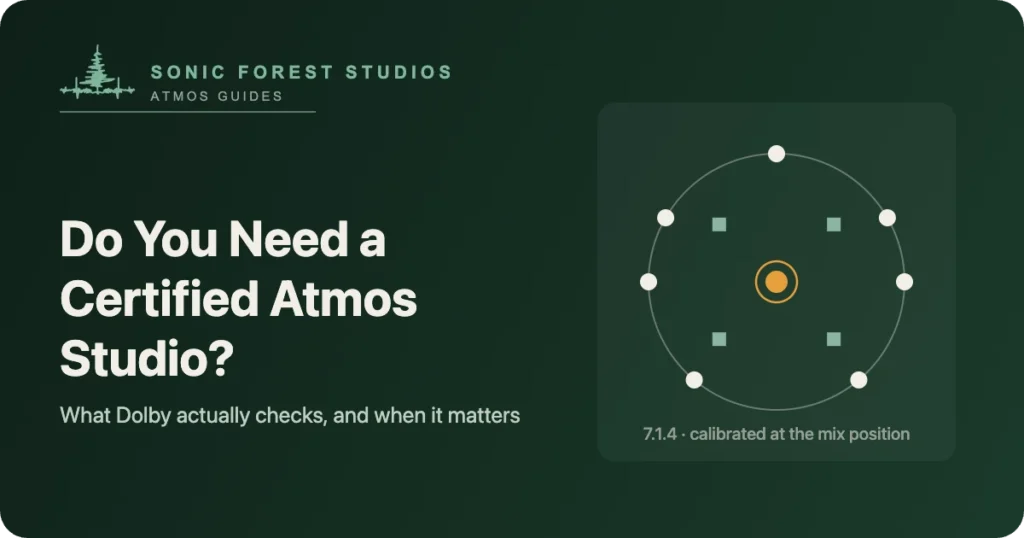
When Dolby certifies a music studio, a Dolby engineer gets involved with the room itself. They look at the physical layout first: speaker positions measured against the 7.1.4 spec, listening distance, the angles on the height channels, and whether the room’s acoustics let you hear what those speakers are doing. Then the monitoring gets calibrated. Level matching across all twelve speakers, bass management, frequency response, SPL at the mix position. Dolby’s own music pages describe the goal plainly: the room should reproduce an Atmos mix the way the format intends it to be heard.
And that’s it. The certificate is a statement about the room, not about the person mixing in it. That distinction matters more than it sounds like it should, so let’s stay on it.
What a certificate doesn’t prove
A certificate doesn’t make anyone a good mixer. A great engineer in an honest, uncertified room will beat a careless one in a certified room every single time. Certification also says nothing about whether your file passes QC. Loudness, true peak, and metadata are on the engineer, not the walls. We covered the five ways masters get bounced in 5 Reasons Atmos Mixes Fail QC, and not one of those failures is prevented by a plaque near the door.
It’s also not a ranking. Dolby isn’t saying a certified room sounds better than every uncertified one. Some uncertified rooms are excellent. The certificate just removes the guesswork about this particular one.
The real problem certification solves: translation
Here’s the thing about Atmos that stereo never prepared us for. A stereo mix plays on two speakers everywhere. An Atmos mix gets rendered differently on every system it meets: a full 7.1.4 theatre, a soundbar, a pair of AirPods running spatial audio, a car. You can’t check all of those. What you can do is mix in a room that sits at the true center of that map, so every rendered version falls where you expect.
Mix in a room where the surrounds run 2 dB hot and you’ll unknowingly pull your rears down. Every listener downstream gets a narrower mix than you thought you made. Mix only on headphones and you’re trusting the binaural render, which is a translation of the mix, not the mix itself. We wrote about exactly what headphones can and can’t tell you in Checking Atmos on Headphones. The calibrated room is the reference point everything else renders from. That’s the whole argument for certification in one sentence.
When a certified Dolby Atmos studio genuinely matters
Labels sometimes require it. If you’re delivering an Atmos master to a major or a distributor with its own QC pass, some contracts name a certified facility as a deliverable condition, and that ends the debate right there.
Film and post work raises the stakes further, since theatrical Atmos and episodic delivery specs assume monitoring you can defend. And if your release genuinely hangs on translation, an album going out to millions of spatial-audio listeners, say, then checking it in a calibrated 7.1.4 room before delivery is cheap insurance against finding out from your audience.
There’s also a plainer reason: honesty in marketing. Anyone can put “Atmos studio” on a website. The certificate is checkable.
How to check what a studio is claiming
Dolby doesn’t publish one simple public directory of every certified music room, so ask the studio directly. Ask what the monitoring layout is. Ask when the room was last calibrated and who did the work. Ask what they check mixes on besides the main array. A studio that went through certification will answer all of that in detail without blinking, because the process forces you to know your own room cold. We’re the first certified Dolby Atmos facility of our kind on Vancouver Island, and we’ll happily bore you with speaker angles if you let us.
One more test that costs nothing: ask how they confirm a mix passes spec before delivery. If the answer includes measured loudness on the 5.1 re-render, true peak, and a metadata pass, you’re talking to people who’ve been through QC. Apple publishes the numbers they hold masters to in the Apple Music specifications, so there’s no excuse for vagueness.
So, do you need one?
For releasing music: no. For knowing your mix translates before the world hears it: that’s the one thing a certified room does that nothing else quite replaces. Plenty of good Atmos work starts in home rigs and headphone sessions. The mixes that ship with confidence tend to finish in a calibrated room, whether that’s for the full mix or a final check. If you’ve got a record that needs to hold up everywhere it lands, our Dolby Atmos mixing page covers rates, the room, and what to send.
FAQ: certified Atmos studios
Do streaming platforms require a certified studio?
No. Apple Music, Tidal and Amazon accept any valid ADM BWF that meets their delivery specs. The specs are about the file, not the room it came from.
What does Dolby actually check during certification?
The room: speaker layout against the 7.1.4 spec, acoustics, and full monitoring calibration including level matching, bass management and SPL at the mix position. It’s a verification of the listening environment, not the engineer.
Can I mix Atmos at home and still get a good result?
Yes, especially if you know your room’s biases. The risk is translation: without a calibrated reference you’re guessing how the mix renders elsewhere. A final check in a certified room catches most of those surprises.
Is a mix from a certified studio more likely to pass QC?
Partly. Loudness and metadata are engineering discipline, not room quality. But balance problems that cause real QC rejections are much easier to hear on calibrated monitoring.
How is a certified room different from mixing on headphones?
Headphones play the binaural render, which is one translation of the mix. The calibrated room plays the mix itself, the version every other render is derived from.
Does a certified studio cost more?
Not necessarily, and certification and price don’t track each other as closely as people expect. Certification is about the monitoring, not the postal code. What matters is whether the room your mix gets judged in is calibrated, so ask that before you compare anything else.
Todd Hooge is the founder of Sonic Forest Studios, the first Dolby Atmos facility on Vancouver Island. He mixes music and film in Atmos from a 7.1.4 room outside Victoria BC, with more than 454 million streams across his Atmos work.