Ever sent a two-line ADR request to a studio and got back a quote that made no sense? Then sent a 300-cue dub to another studio and got a number that seemed too low? Both happened to me before I ran a studio, and both came down to the same thing: nobody explained what the number was made of. (I wrote the same kind of breakdown for Atmos mixing a while back.)
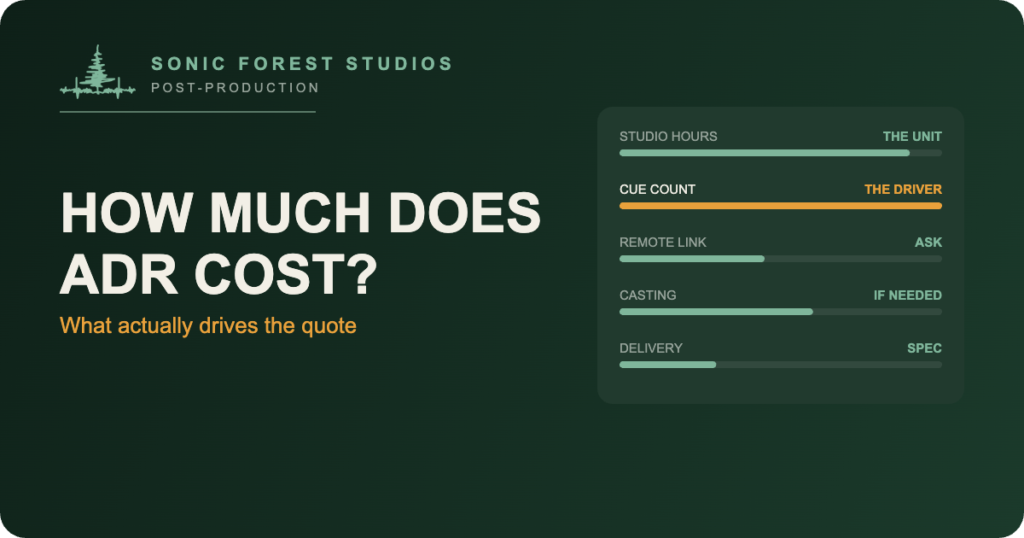
So here’s the short answer to how much does ADR cost. Most studios bill by the hour with a two-hour minimum, and the real total depends on five things: how many cues you have, how hard they are, whether your supervisor is directing remotely, who’s booking the talent, and what the post house needs delivered. I’m not going to put my own rates in a blog post. They change with the project and I’d rather quote you properly than have you anchor on a number that was written for someone else’s film. But I’ll tell you exactly what moves the price, and what to ask any studio before you book.
The hour is the unit, not the line
Almost every ADR studio bills by the studio hour, with a minimum. Two hours is common. Some rooms run a half-day or full-day rate for bigger jobs. That’s the starting point, and it’s why a “two-line pickup” is rarely as cheap as it sounds: the room, the engineer and the setup are the same whether the actor says two lines or twenty.
What changes is how many hours the work actually takes, and that’s where cue count comes in.
Cue count and cue difficulty
A cue is one line, or one chunk of a line, that gets replaced. A clean pickup on a well-rested actor might take three takes. An emotional scene with a fast overlap might take fifteen. As a rough working number, an experienced actor with a good streamer and a supervisor who knows what they want will clear somewhere between 15 and 30 cues an hour. Kids, accents, and anything with singing move slower. A lot slower, sometimes.
I’ll give you a real example. On a recent narration job for a Toronto post house, the cue sheet had 22 voice-over cues spread over four reels, and one of those “cues” was actually a 28-second montage of four separate lines. That one “cue” is four performances, four sync points, four chances to go again. The sheet said 22. The session was never going to feel like 22.
So when a studio asks for your cue sheet before quoting, that’s not stalling. It’s the only way to give you a real number.
Remote direction
Ten years ago, remote direction meant a phone patch and hope. Now it means your supervisor hears the studio’s mic feed in broadcast quality from Toronto or Los Angeles, on a normal video call, and approves takes live. Some studios charge extra for that link. Some include it. (I wrote up how a remote ADR session actually runs here, step by step.) Ask, because it’s a big part of the value on any session where the post house isn’t in the same city as the actor.
The related question: does the studio need you to install anything? The good setups don’t. Your supervisor should be able to join from a standard Zoom client and hear the real feed through something like Source-Nexus, which runs inside the studio’s Pro Tools rig and pushes the actual mic signal into the call. If the studio’s answer is “just listen on Zoom,” the audio they’re judging is compressed and delayed. That’s worth knowing before you book.
Prep time
Somebody has to build the session, load the cues, check the frame rate against your reference, and make sure the streamer and beeps land on the frame. If your cue sheet comes out of EdiCue or ADR Master as a data export, that’s fast. Cue Pro, the cueing app I run, pulls those straight in, along with CSV, Excel and Netflix TTAL files. If it’s a PDF from the dialogue editor’s notes, somebody rebuilds it by hand, and that’s an hour or two of somebody’s time. Some studios bill prep as a flat line; some fold it into the minimum. Either is fine, but you want to know which.
Frame rate deserves its own sentence. A 23.976 project loaded at 24 will drift, and you won’t find out until the mixer does. Any studio worth booking checks this before the actor arrives. I do it against the picture file itself, not the email, because I’ve been burned by an email once and that was enough.
Casting and talent
If the original actor is doing their own ADR, there’s no casting cost. If you’re replacing a voice, dubbing into another language, or building loop group, someone has to find and book performers, and that’s a real cost whether the studio handles it or you do. In Canada, performers working under ACTRA’s Independent Production Agreement come with engagement rules and a work report that gets signed at wrap, and a studio that’s done it before will save you a day of emails.
For a full dub the casting is most of the job. The English dub of Sugar Candy that ran through my room had 16 speaking characters, cast through a Victoria agency, and the lead alone had 238 lines. Nobody quotes that from a synopsis. They quote it from the script.
Delivery
Dry 24-bit/48kHz BWF files, named by cue and organized by character, is the standard and shouldn’t cost extra. What sometimes does: cleaned and edited files versus raw takes, a full Pro Tools session handed over with playlists expanded onto separate tracks, or specific naming conventions for a particular post house. The Toronto houses I’ve delivered to each have a spec sheet, and they’re all a little different. Ask what the studio’s default delivery is and what’s on top.
What the big-city rooms charge for that you might not need
The purpose-built ADR stages in Vancouver, Toronto and LA are worth what they charge for a series with a big cast and a supervisor in the building every day. If you have one actor on Vancouver Island and a mix schedule in Toronto, you’re paying for a stage you’ll use for two hours, plus the actor’s flight and a day of their time. That’s the math that sends a lot of my work my way, and it’s worth running before you book anywhere.
And the same logic runs the other way. If you’ve got twelve actors and a supervisor who wants to be in the room, book the stage. I’d tell you that too.
What to ask before you book (steal this)
What’s your minimum, and does prep count toward it?
How many cues an hour do you usually clear?
Can my supervisor hear the real mic feed, and what do they need to install?
What cue sheet formats do you take?
What do you deliver by default, and what costs extra?
Do you check frame rate before the session?
Who books the talent, and have you handled ACTRA paperwork?
Use that list on me. I’d rather answer all seven up front than have a surprise on the invoice. And if you’ve got a cue count or a script, send it over through the ADR page and I’ll come back with a real number and a realistic timeline.
Frequently asked questions
Is ADR charged per line or per hour?
Per hour, almost everywhere, with a minimum booking. Cue count is what determines how many hours you’ll need, so the studio will want the cue sheet before quoting.
Does remote direction cost extra?
Depends on the studio. Some bill the remote link as a line item and some include it. Ask what your supervisor will hear (the real mic feed or plain Zoom audio) and whether they need to install anything.
How many ADR cues can you record in an hour?
With an experienced actor and a supervisor who knows what they want, somewhere between 15 and 30. Kids, accents, singing and emotional scenes run slower.
What does an ADR studio need from me to give a quote?
The cue sheet (or the script, for a dub), the frame rate, the picture format, your delivery spec, and whether the supervisor is attending remotely. With those five things a studio can quote in a day.
Is it cheaper to fly the actor to a big-city stage?
Usually not, if it’s one actor and a handful of cues. Once you add the flight, the hotel and a day of the actor’s time, a remote-directed session near where the actor already is tends to win. For a big cast with the supervisor in the room, the stage makes more sense.
Todd Hooge is the founder of Sonic Forest Studios, the first Dolby Atmos certified facility on Vancouver Island. He records ADR and mixes film and music in Atmos from a 7.1.4 room outside Victoria BC.