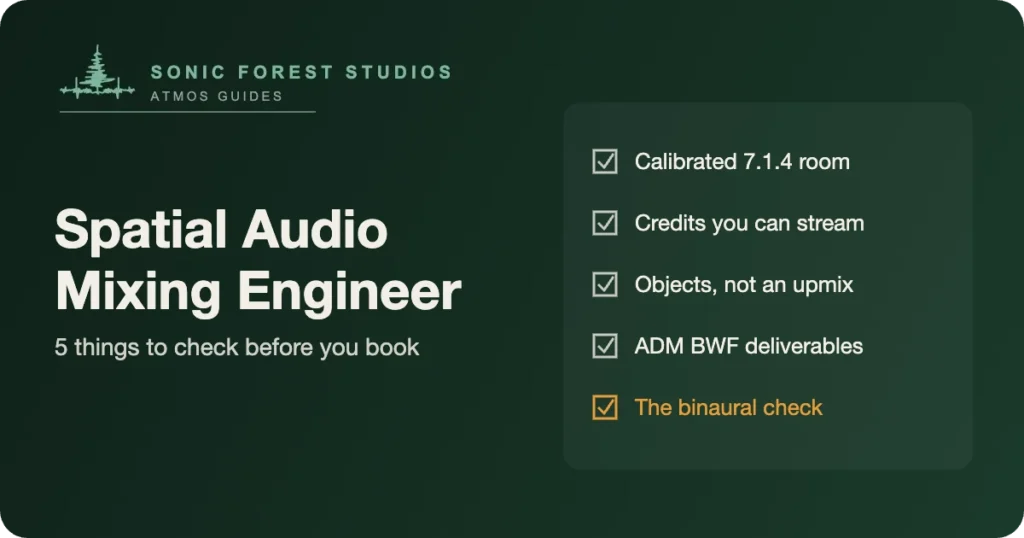
Who should mix your spatial audio? Here’s the direct answer: a spatial audio mixing engineer with a calibrated 7.1.4 room, released credits you can stream right now, and a workflow built on objects and metadata rather than a stereo upmix. Titles are cheap in this field. Plenty of people bought a renderer licence in 2021 and added spatial audio to their bio the same week, and from the outside their websites look identical to the real thing. The five checks below separate an engineer who mixes spatial audio for a living from someone who owns the software, and you don’t need to understand the technology to run any of them. I’ve mixed in Dolby Atmos exclusively since January 2021, so I’ll also tell you which of these checks I’d weight hardest.
What a spatial audio mixing engineer actually does
Stereo gives you two channels and one decision: left to right. Spatial audio gives you a sphere. A spatial audio mixing engineer takes your stems and rebuilds the record as beds and objects, each with its own position and its own rendering behaviour, then verifies the result everywhere it will play. That last part is most of the job. Your mix gets rendered on the listener’s device, not shipped as one finished file, so the engineer has to know how a placement decision made on twelve speakers survives the fold-down to a soundbar, a car, and the binaural version on AirPods. Roughly that order of difficulty, reversed in importance… binaural is what most of your audience hears first.
Check 1: a calibrated room, not a plugin
Ask what their room is calibrated to and who verified it. The honest answers sound specific: a 7.1.4 layout, level-matched and tuned, measured against Dolby’s studio standards, sometimes certified by Dolby outright. The evasive answers lean on headphones and software. But here’s the thing about mixing spatial audio on headphones alone: you’re making placement decisions inside a simulation of the thing you’re supposed to be verifying. I wrote about what certification does and doesn’t mean in Do You Need a Certified Atmos Studio, and the short version holds here. The room is the instrument. An engineer who can’t describe theirs hasn’t got one.
Check 2: credits you can stream tonight
Ask for three released spatial mixes and then actually stream them, in spatial audio, on your own ears. Not demo reels. Not before-and-after clips on their site, which can be cherry-picked or upmixed. Released music on Apple Music, Amazon Music or Tidal with the spatial badge showing. This check takes ten minutes and filters out more pretenders than any other question on this list. While you listen, pay attention to whether the mix still feels like a record. The most common failure in spatial audio isn’t technical, it’s taste: elements scattered around the sphere because they can be, vocals swimming somewhere behind your head, energy lost from the centre. A good spatial mix is still a mix first.
Check 3: objects, not an upmix
Some services quietly run your finished stereo master through an upmixer, spread it across the sphere, and sell the result as a spatial mix. It isn’t one. Ask one question: do you mix from my stems or from my stereo file? The right answer involves your stems, placed deliberately, element by element. If you want to know what to prepare, Dolby Atmos Stems: How to Prepare walks through the four things an engineer needs. An upmix has its place as a cheap catalogue treatment, I guess, but if you’re paying for a spatial mix of a record you care about, you should be getting placement decisions made by a person, not an algorithm’s best guess.
Check 4: they talk deliverables before they talk art
Spatial audio lives and dies on specifications. Apple wants integrated loudness at or below -18 LKFS and true peak under -1 dBTP, delivered as an ADM BWF at 48 kHz, and Apple publishes those requirements for anyone to read. A working spatial audio mixing engineer will mention those numbers before you ask, because a mix that fails platform QC doesn’t exist as far as your release date is concerned. Ask what file you’ll receive and what loudness it hits. Then ask who handles it when a platform kicks the file back. The answer should be them, at no drama to you.
Check 5: the binaural answer
Here’s my favourite filter question, and the one I’d weight hardest: how do you check the binaural render? Most spatial audio gets heard on ordinary earbuds through each platform’s binaural fold-down, so an engineer who only plays you the speaker version has verified the minority experience. The real workflow checks the binaural render against the speaker mix throughout, adjusts render modes per object, and listens on the cheap earbuds your audience owns, not just studio headphones. I covered what binaural can and can’t tell you in Checking Atmos on Headphones. An engineer who waves this question off is shipping mixes most listeners will hear unchecked.
Where to start
You don’t need to live near a major market anymore. Stems travel over the internet and calibrated rooms exist well outside Los Angeles and London now, which has quietly changed who gets access to this work. I run these five checks in reverse on myself every so often, honestly, because they’re the standard the work deserves. If you’re weighing options, our spatial audio mixing page covers how we approach it from a certified 7.1.4 room, and I’m happy to answer any of the five questions above about my own setup before you send a single file. That offer stands whoever you end up booking with.
Frequently asked questions
Who mixes spatial audio for music?
Spatial audio mixes come from specialist mixing engineers working in calibrated multichannel rooms, usually 7.1.4 Dolby Atmos setups. Some work inside major studios, many work independently. What matters isn’t the building, it’s the calibrated monitoring, the released credits and an object-based workflow rather than a stereo upmix.
What does a spatial audio mixing engineer do?
They take your stems and rebuild the mix as objects and beds in three-dimensional space, then verify it translates everywhere: a calibrated speaker room, a soundbar, and the binaural render most listeners hear on earbuds. The deliverable is an ADM BWF master that passes platform QC.
Can my stereo mixing engineer do my spatial audio mix?
Sometimes, but ask how. If the plan is running your finished stereo mix through an upmixer, that’s not a spatial mix, and platforms and listeners can tell. A real spatial mix starts from your stems and places each element deliberately.
How do I check if a spatial audio engineer is legitimate?
Ask for three released credits and stream them in spatial audio yourself. Ask what their room is calibrated to and who verified it. Ask what loudness and true peak they deliver to. Confident, specific answers to all three usually means you’re in good hands.
Do I need a certified studio for spatial audio?
Certification tells you the room was measured and verified by Dolby, which removes guesswork about the monitoring. It’s not the only signal that matters, but an uncalibrated room means every placement decision was made somewhere your mix can’t be trusted.
What should I send a spatial audio mixing engineer?
Printed stems at 48 kHz, your FX busses, a stereo reference and clear labels. Dry stems with the effects separate give the engineer room to place things. A finished stereo master alone isn’t enough to mix from.
Todd Hooge is the founder of Sonic Forest Studios, the first Dolby Atmos facility on Vancouver Island. He mixes and masters music and film in Atmos from a 7.1.4 room outside Victoria BC, with more than 456 million streams across his Atmos work.