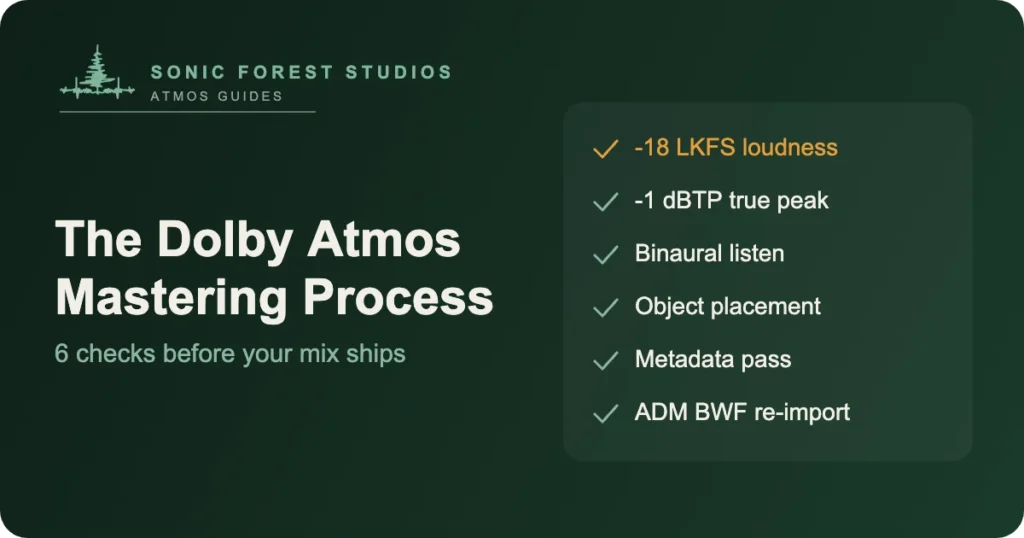
The Dolby Atmos mastering process comes down to six checks: integrated loudness at or below -18 LKFS, true peak under -1 dBTP, a start-to-finish binaural listen, an object placement review, a metadata pass, and a final ADM BWF that opens clean at 48 kHz. Your master passes all six or it doesn’t ship. That’s the whole job in one sentence, and it’s also why mastering for Atmos looks nothing like stereo mastering. There’s no limiter to lean on and no single stereo file to polish. What you’re actually finishing is a session full of beds, objects and metadata that has to behave everywhere, from a calibrated 7.1.4 room to a $30 pair of earbuds.
Why this isn’t stereo mastering with more speakers
Stereo mastering is mostly about tone and level on one file. You EQ it, you limit it, you print it. Atmos mastering can’t work that way because the “file” doesn’t exist until playback. Apple Music, Amazon Music and Tidal all render your mix on the listener’s device, in real time, from the stems and metadata you delivered. So the mastering job shifts from shaping a waveform to verifying a system. I think of it less like polishing and more like pre-flight.
The six checks below are the ones I run at Sonic Forest Studios on every master before it leaves the room. They’re in this order for a reason. The cheap failures come first.
Check 1: integrated loudness at -18 LKFS
Every streaming platform that accepts Atmos measures your master’s integrated loudness, and Apple’s ceiling is -18 LKFS. Come in louder and you fail ingestion. Come in way under and the platform’s normalization leaves your track sounding small next to everything else on the playlist. The target has a surprising amount of room to sound big, but only if the dynamics are doing the work instead of density. I wrote up why that is in Why Does My Atmos Mix Sound Quiet?, and it’s the number one thing artists ask about after their first Atmos release.
Check 2: true peak under -1 dBTP
The second gate is true peak, measured after reconstruction, not just sample peaks. The limit is -1 dBTP on the re-render. This one bites mixes that were printed hot in the box and looked fine on a sample-peak meter. A master can pass loudness and still fail here, usually on a transient that only exceeds the ceiling once the renderer sums objects into a bed. I check it on the 7.1.4 re-render and the binaural re-render both, because they can disagree.
Check 3: the full binaural listen
Most of your audience will never hear your Atmos mix on speakers. They’ll hear Apple’s binaural render on AirPods, on the bus. So a master that only got checked on monitors isn’t mastered. I listen to the binaural render top to bottom, at low level and at commute level, listening for elements that collapse, vocals that drift back, and lows that vanish. It turns out the binaural render is honest about different things than the room is, and you need both stories before you sign off.
Check 4: object placement review
This is the spatial sanity pass. Are the objects where the mix notes say they should be? Does anything hard-panned to a height channel fold down into mono mush? Is the center image stable when the renderer collapses 7.1.4 to 5.1, to stereo, to binaural? Placement problems are mix problems, strictly speaking, but mastering is the last set of ears that will ever catch them. Five of the failures I see most often live here, and I listed them in 5 Reasons Atmos Mixes Fail QC.
Check 5: the metadata pass
Every object in your session carries metadata: position, size, and the binaural render mode that tells headphone playback whether that element sits near, mid, or far. Leave a lead vocal on the wrong render mode and the headphone version of your song has the vocal in a different place than the speaker version. Downmix trims matter here too, since they decide how the 5.1 and stereo folds behave. None of this is audible in the session by default. You have to open the metadata and read it, line by line, which is exactly the kind of unglamorous work mastering exists for.
Check 6: the ADM BWF itself
The deliverable is a single ADM BWF file: every bed, every object, and all that metadata wrapped into one broadcast WAV at 48 kHz. The last check is the file itself. Does it re-import into a clean session with everything intact? Does the checksum match after transfer? Does it open in the Dolby Atmos Renderer without warnings? I covered what’s inside the format in ADM BWF Explained, and Dolby publishes the full delivery specification on its professional music pages. A master that fails to re-import is not a master. It’s a hope.
What passing looks like
When all six checks clear, you get a file that ingests without a bounce-back, plays at full level next to major-label releases, and sounds like the same song on speakers, soundbars and earbuds. Apple documents its delivery requirements through Apple Music for Artists, and the platforms do enforce them. The mixes that sail through are the ones where somebody ran this list before upload instead of after rejection.
So here’s the question worth asking before your next release: has anyone actually run these six checks on your master, in a calibrated room, or did the file go straight from the mix session to the distributor? If you’re not sure, that’s usually the answer. Our Dolby Atmos mastering page covers how we handle the pre-flight, and I’m happy to look at a master before you commit it.
Frequently asked questions
What is the Dolby Atmos mastering process?
It’s a six-part verification pass: integrated loudness at or below -18 LKFS, true peak under -1 dBTP, a full binaural listen, an object placement review, a metadata check, and a final ADM BWF that re-imports clean at 48 kHz.
Can you master an Atmos mix the same way as stereo?
No. There’s no single file to process and no brickwall limiter in the chain. The platforms render your mix on the listener’s device from stems and metadata, so mastering becomes verification of that whole system rather than processing of one waveform.
What loudness should a Dolby Atmos master hit?
Apple’s ceiling is -18 LKFS integrated with true peaks under -1 dBTP. Most masters land close to the ceiling. Going quieter is allowed but usually costs you level against normalized playlists.
Do I need separate Atmos mastering if my mix already passed QC?
QC and mastering overlap but aren’t the same pass. QC asks whether the file is technically valid. Mastering also asks whether the music translates, at level, on binaural, next to the records it will be playlisted with.
What file do I get after Dolby Atmos mastering?
One ADM BWF: a 48 kHz broadcast WAV containing every bed, object and piece of metadata. That single file is what your distributor sends to Apple, Amazon and Tidal.
Why does my Atmos master sound different on headphones?
Headphone listeners hear a binaural render, not your speaker mix, and each object’s render mode decides how it sits in that version. If nobody checked the binaural render during mastering, nobody heard what most of your audience will hear.
Todd Hooge is the founder of Sonic Forest Studios, the first Dolby Atmos facility on Vancouver Island. He mixes and masters music and film in Atmos from a 7.1.4 room outside Victoria BC, with more than 456 million streams across his Atmos work.