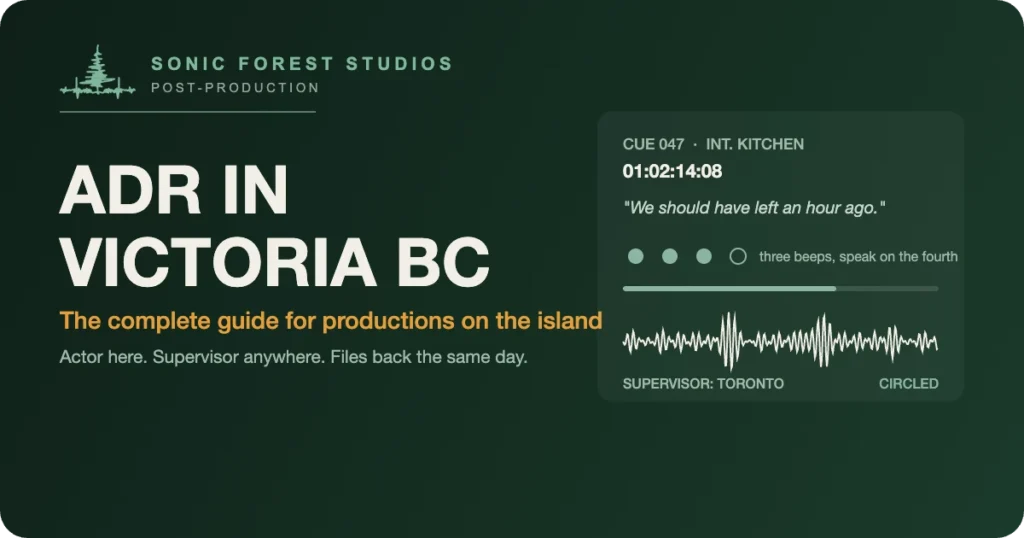
Need ADR in Victoria BC? Here’s the direct answer. If your actor lives on Vancouver Island, is shooting here, or is home for the week, you don’t have to fly them to Vancouver or Toronto for two cues. The session happens in an ADR recording studio outside Victoria, your supervisor directs live over a standard video call while hearing the real studio feed in broadcast quality, and the files land in your post house’s transfer system the same afternoon. That’s how most of my ADR work runs now, for series and features supervised out of Toronto, Vancouver and Los Angeles. This guide covers the rest: when a production actually needs ADR, how a local session runs from cue sheet to delivery, how replaced lines get matched to production sound, what the island offers for casting, and the mistakes that cost real money.
I run the ADR recording studio inside the first Dolby Atmos certified 7.1.4 room on Vancouver Island, and I’ve written two narrower pieces already: what drives an ADR quote, and a minute-by-minute walkthrough of one remote session. This one is the map those two sit on.
Why ADR in Victoria BC comes up at all
Victoria and the rest of Vancouver Island host a steady run of production: Hallmark and other movie-of-the-week shoots, CBC and APTN series, documentaries, independent features, and a lot of performers who simply live here between jobs on the mainland. Post, though, happens somewhere else. The dialogue editor is in Toronto, the mixer is in Vancouver or LA, and the mix schedule doesn’t care about the ferry. So a post coordinator ends up searching for a room near the actor rather than near the mix stage. In September an actor stood in my booth recording two cues for a CBC series, one in English and one in Cree, while the ADR supervisor listened from Picture Shop in Toronto and a Cree translator joined the call for the second cue. Booth to wrap was about an hour and ten minutes. Nobody flew anywhere.
The other local case is the production that shot here and wants to finish here. Island producers use the room for ADR and for the final mix so nothing has to cross to the mainland, and the director can sit in the room and hear the real monitor feed.
What ADR actually is, and where the name came from
ADR is Automated Dialogue Replacement: re-recording an actor’s lines in a studio, to picture, after the shoot. The “automated” part is a fossil from the looping era, when a few seconds of film ran around a physical loop and a machine rolled, played, recorded and reset each pass. The machinery is gone. The word stayed. In Britain you’ll still hear “post-sync”, and plenty of people just say “looping”. The goal hasn’t changed: good ADR is invisible, and the audience never hears the edit between a production line and a replaced one. That’s why most of this guide is about matching, not microphones.
When a production needs ADR
Five situations account for nearly all of it. Technical problems on set: traffic under a quiet scene, a fridge hum nobody noticed, a boom too far away, two actors stepping on each other’s lines. Story changes after the edit: a restructured scene, a renamed character, a line moved somewhere the actor never said it. Additions: off-screen lines, phone voices, crowd murmur (loop group, or walla), narration, and anything a broadcaster asks for in a standards pass. Dubbing, which is ADR at scale, every line in a new language against a script adapted to fit the mouths on screen; the biggest job this room has taken on was a full English dub of a Czech-Slovak feature, 1,171 cues across 16 characters, cast through a Victoria agency and delivered to the mixer in Bratislava. And the quiet fifth reason: performance. Nothing was wrong on set, the director just wants a different read.
Who’s in the room, and who’s on the link
Four roles matter. The ADR supervisor or dialogue editor owns the cue sheet. The director or showrunner may join for performance notes. The actor does the hard part. And the engineer runs picture, playback, mics and the session, and is responsible for the files matching what the mixer needs. Twenty years ago all four shared a building. Now, for a session in Victoria, the first two are almost always somewhere else. The thing that makes remote direction work is sending the supervisor the actual studio feed in broadcast quality rather than the compressed audio a call app gives them. They have to judge the real mic signal. If they’re hearing a squashed version, they’ll approve takes that don’t match.
How a session runs here, start to finish
It starts before anyone records. You send the cue sheet and the picture. Cue sheets arrive in whatever you already use (EdiCue exports, ADR Master projects, a spreadsheet, Netflix’s TTAL script format) and go into Cue Pro inside Pro Tools, which draws the cue text and countdown straight onto the picture the actor sees. Frame rate gets confirmed before the first take; a 23.976 picture against a 24 fps session drifts by an amount you won’t catch in the booth and the mixer will.
On the day, the actor stands in the booth with the picture in front of them. For each cue they hear the original line once or twice, then three beeps and a visual streamer sweep across the screen, and the line starts where the fourth beep would be. The supervisor listens on the link, gives a note, and they go again. Most cues take three to six takes. The supervisor circles a take and the next cue comes up.
Files go back the same day over whatever transfer your post house uses (Signiant Media Shuttle is common with the Toronto houses): 24-bit, 48 kHz Broadcast Wave, dry and unprocessed, one file per take, named by cue, organized by character, session starting at 00:00:00:00 so everything drops onto its own timecode in the dialogue editor’s timeline. If you want the Pro Tools session too, you get it.
Matching: the part that separates ADR from voice-over
Voice-over just has to sound good. ADR has to sound like something else, and four things have to match.
The microphone. If the scene was boomed on a short shotgun, the replacement should be recorded on the same or a very close mic at a similar distance and angle. Most ADR here goes down on two tracks at once, a shotgun that matches a typical production boom and a lavalier on the body that matches the radio mic the sound team ran, so the dialogue editor has the same choice they had on set. Send a mic list and the studio should match it.
The perspective. A line delivered across a kitchen doesn’t sound like one whispered into an ear. The actor plays the distance and energy; the engineer places the mic to agree.
The room. Production dialogue carries the location. The booth should carry as little of itself as possible, so the mixer can put the location back with reverb and matched room tone. Quiet and neutral is the goal, which is why a treated, separate booth matters more than any single piece of gear.
The performance. Breath, pace, the energy of the moment, whether the actor was moving. A technically perfect take with the wrong energy sticks out more than a slightly early one with the right energy. Good supervisors direct for the scene and fix sync in the edit.
Casting and talent on Vancouver Island
For dubbing and larger projects I work with a professional Victoria casting agency, and I keep a growing list of island voice talent for smaller ones. If you need a local performer to match a voice, send the reference and you’ll get options back. Loop group and walla run the same way as ADR: cued, to picture, with the supervisor listening live.
What actors can do to make it go well
Watch the scene before the session. Know what you were doing physically; if you were walking, move a little in the booth. Don’t try to beat the beeps; let the rhythm carry you in. Match your own breath. Ask for the original line again whenever you want it. And hydrate and warm up, because forty cues at the same emotional pitch will wear a voice down by the thirtieth.
The mistakes that cost real money
The frame rate one. Cue sheets with no reasons, so nobody knows whether a line is being replaced for noise (match exactly) or story (new read, sync to the mouth). Picture without a burned-in timecode window. Dubbing scripts that were translated but not adapted. Booking before the edit is locked, then paying for a second session when the cut changes. And skipping the second sync check in the booth: a slip you don’t catch while the actor is standing there is a slip the mixer catches after the actor has gone home.
Choosing an ADR studio in Victoria BC, or anywhere
Ask four questions. Can your supervisor direct remotely and hear the real studio feed? What cue sheet formats come in without rebuilding by hand? Will they match your production mics? And what do the delivered files look like: naming, format, timecode start, dry or processed. If the room also has to satisfy a streamer’s dubbing spec (Netflix publishes theirs openly), ask whether they’ve delivered to it. A studio that answers all four plainly has done this before.
Frequently asked questions
Is there an ADR studio in Victoria BC?
Yes. Sonic Forest Studios records ADR, dubbing and voice-over just outside Victoria on Vancouver Island, with remote direction for supervisors in Toronto, Vancouver, Los Angeles or anywhere else, and same-day file delivery to the post house.
Can our supervisor direct an ADR session in Victoria remotely?
Yes, and most do. They join a standard video call and hear the studio feed in broadcast quality rather than the call app’s compressed audio, so they judge the real mic signal and talk to the actor between takes. Nothing to install.
What does ADR stand for?
Automated Dialogue Replacement, sometimes called Additional Dialogue Recording: re-recording an actor’s lines in a studio, to picture, after the shoot. The “automated” part refers to old looping machinery; the process itself is a craft.
How long does an ADR session take?
Roughly ten to twenty cues an hour for straightforward replacement, slower for emotionally demanding or heavily adapted dubbing lines. Most cues take three to six takes, and a two-hour minimum is common for small pickups.
What files does an ADR studio deliver?
The common standard is 24-bit, 48 kHz Broadcast Wave files, dry and unprocessed, one per take, named by cue and organized by character, with the session starting at 00:00:00:00 so they land on their own timecode in the dialogue editor’s session.
Why does frame rate matter for ADR?
If the session frame rate doesn’t match the picture (23.976 against 24, for example), takes drift against the image by an amount too small to catch in the booth and large enough for the mixer to see. Confirm the frame rate before the first cue.
Todd Hooge is the founder of Sonic Forest Studios, the first Dolby Atmos facility on Vancouver Island. He records ADR and dubbing and mixes music and film in Atmos from a 7.1.4 room outside Victoria BC, with more than 457 million streams across his Atmos work.