Is there such a thing as lossless Dolby Atmos on a streaming service? No. Apple Music, Tidal and Amazon Music all stream a lossy version of your Atmos mix, at a few hundred kilobits per second. The lossless kind reaches listeners in two places only: on Blu-ray, and in paid downloads. And the full mix, every object exactly where I put it, lives in one file that never leaves the studio pipeline. That’s the short answer. The rest of this article is the table I wish somebody had handed me, plus what it means for your release.
Here’s how I ended up writing it. A friend told me a while back that Apple had started streaming “full” Atmos, more than six channels. I was in the studio on a Sunday afternoon, listening to Apple Music through the room, when I finally decided to check. It turns out he was half right. And the half he had wrong is the part most people get wrong.
What each source actually delivers
| Source | What you actually get | Lossless? | Bitrate | What’s inside |
|---|---|---|---|---|
| Apple Music | Dolby Digital Plus with Joint Object Coding | No | Up to 768 kbps | Up to 16 elements |
| Tidal | Dolby Digital Plus with Joint Object Coding on speakers. A binaural codec (AC-4 IMS) for headphones on mobile. | No | 768 kbps is the codec’s ceiling | Up to 16 elements |
| Amazon Music | Dolby Digital Plus with Joint Object Coding | No | 448 or 768 kbps | Up to 16 elements |
| Spotify | No Atmos at all | Stereo only | n/a | n/a |
| Paid download (Immersive Audio Album, 2L) | Dolby TrueHD file | Yes | Same family as Blu-ray | Up to 16 elements |
| Blu-ray | Dolby TrueHD | Yes | Around 6,000 kbps on average, peaks up to 18,000 | Up to 16 elements |
| ADM BWF master | Uncompressed PCM plus metadata | Yes, it’s the original | About 147 Mbps if all 128 inputs are used | Up to 128 channels: 10 beds and 118 objects |
Download this comparison as a one-page PDF.
Why there’s no lossless Dolby Atmos on streaming
It comes down to data. Every streaming service uses the same delivery codec for speakers: Dolby Digital Plus with Joint Object Coding. It tops out at 768 kbps, and that’s for the whole mix, not per channel. Morten Lindberg of the Norwegian label 2L, who releases the same albums both ways, told Stereophile his lossless TrueHD files average around 6,000 kbps. So the lossless version carries roughly eight times the data. No music service wants to pay for that much bandwidth on every play. Not yet, anyway.
Is 768 kbps bad? I don’t think so. For a stereo file it’d be generous. But an Atmos stream is doing a much bigger job with it, and I can hear the difference in my room on material I know well. You might not on earbuds. Both things can be true.
The “lossless” badge on Tidal and Amazon isn’t about Atmos
This one catches a lot of people, and I get why. Tidal and Amazon Music both advertise lossless and hi-res audio, and both carry Dolby Atmos. So it’s natural to assume you’re getting lossless Atmos. You’re not. The lossless part is their stereo catalogue, delivered as FLAC. The Atmos tracks sit in a separate lane and use the same lossy codec Apple uses. Tidal actually runs two paths, according to Lindberg: Dolby Digital Plus for speaker systems, and a binaural codec for headphones on mobile.
Spotify is the odd one out. It added lossless stereo in September 2025 and still has no Atmos at all.
The six-channel myth
So what about my friend’s “more than six channels”? The stream was never limited to six. As I understand the format, it carries a 5.1 core that older gear can play, plus metadata riding alongside. A decoder that understands Atmos uses that metadata to rebuild the mix into as many as 16 separate elements, then renders those to whatever speakers you have. That’s been true since Apple Music launched Atmos in 2021. What changed later was playback gear catching up, including the Mac, which can now feed a full 7.1.4 speaker layout from the Music app.
But notice that number. Sixteen.
Where lossless Dolby Atmos actually lives
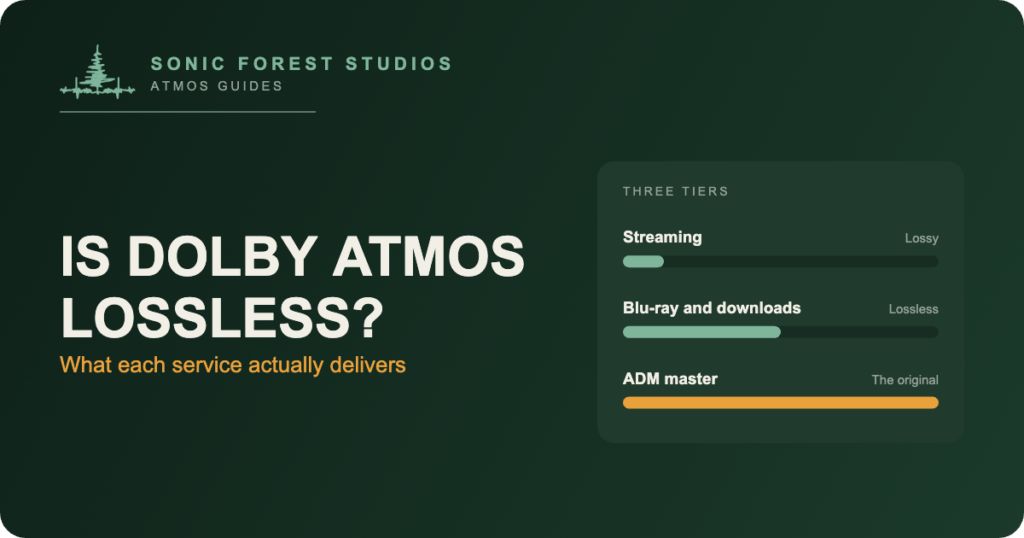
There are three tiers, not two, and I think that’s the part worth remembering.
Streaming sits at the bottom. It’s lossy, and the mix is grouped down to a maximum of 16 elements.
Blu-ray and paid downloads are the middle. These use Dolby TrueHD, which is lossless, so what comes out is bit-for-bit what went in. Labels like 2L and shops like Immersive Audio Album sell albums this way. It’s a real step up. It’s still the home version of Atmos, though, so the same 16-element grouping applies.
The ADM BWF master is the top, and it’s the only place your full mix exists. Dolby’s ADM master profile sets it at up to 128 channels (10 bed channels and 118 objects) of PCM at 48 kHz. That’s the file I deliver at the end of a mix, and every stream and every disc gets made from it. If you want the details, I wrote up what an ADM BWF file is separately.
Nobody outside a studio ever hears that top tier directly. Kind of a shame, honestly.
What this means for your release
Don’t let any of this put you off. The stream is where your listeners are, and a well-made Atmos mix survives the trip. It does change how the work should be done, though. A mix has to be checked the way people will hear it, which means through the encode and on headphones, not only on big speakers in a treated room. I covered that in checking Atmos on headphones, and the delivery numbers are in Apple Music’s spatial audio requirements.
And if your audience includes the kind of listener who buys discs or downloads, a lossless release is worth a conversation. It’s the same master. It just needs a different door out of the building. If you’re still deciding whether Atmos makes sense at all, start with is Dolby Atmos worth it. And if you’d like to talk through a project, the mixing page has the details. Ask for a quote and I’ll tell you what I’d do with it.
Lossless Dolby Atmos: common questions
Is Dolby Atmos on Apple Music lossless?
No. Apple Music streams Atmos in Dolby Digital Plus with Joint Object Coding, a lossy codec, at up to 768 kbps. Apple’s Lossless and Hi-Res Lossless tiers apply to the stereo version of a track. A song can show both badges, but you’re hearing one or the other, never both at once.
Do Tidal or Amazon Music stream lossless Dolby Atmos?
No. Both use the same lossy codec as Apple Music for Atmos on speakers. Their lossless and hi-res claims cover the stereo FLAC catalogue only. Amazon’s Atmos streams run at 448 or 768 kbps, so they can be lower than Apple’s.
Where can I hear lossless Dolby Atmos music?
On Blu-ray, and in paid downloads from labels and stores that sell Dolby TrueHD files, such as 2L and Immersive Audio Album. Both need a player and a receiver that can decode TrueHD. No major streaming service offers it.
Is streaming Dolby Atmos limited to 5.1?
No. The stream carries a 5.1 core plus metadata, and an Atmos decoder uses that metadata to rebuild up to 16 separate elements. Those get rendered to your speaker layout or to headphones. If you only hear 5.1, it’s usually the playback setup folding the mix down, not the stream.
Can you hear the difference between lossy and lossless Atmos?
On a good speaker system with familiar material, often yes. On earbuds, probably not. Engineers disagree on how big the gap is. Some call streaming Atmos a pale version of the master, and others consider 768 kbps perfectly respectable for a multichannel stream.
Does my Atmos master change depending on where it’s released?
No. One ADM BWF master feeds everything. The streaming services encode their lossy versions from it, and a Blu-ray or download release encodes a lossless TrueHD version from the same file. You approve one mix, and it goes out through different doors.
Todd Hooge is the founder of Sonic Forest Studios, the first Dolby Atmos facility on Vancouver Island. He mixes and masters music and film in Atmos from a 7.1.4 room outside Victoria BC, with more than 457 million streams across his Atmos work.