
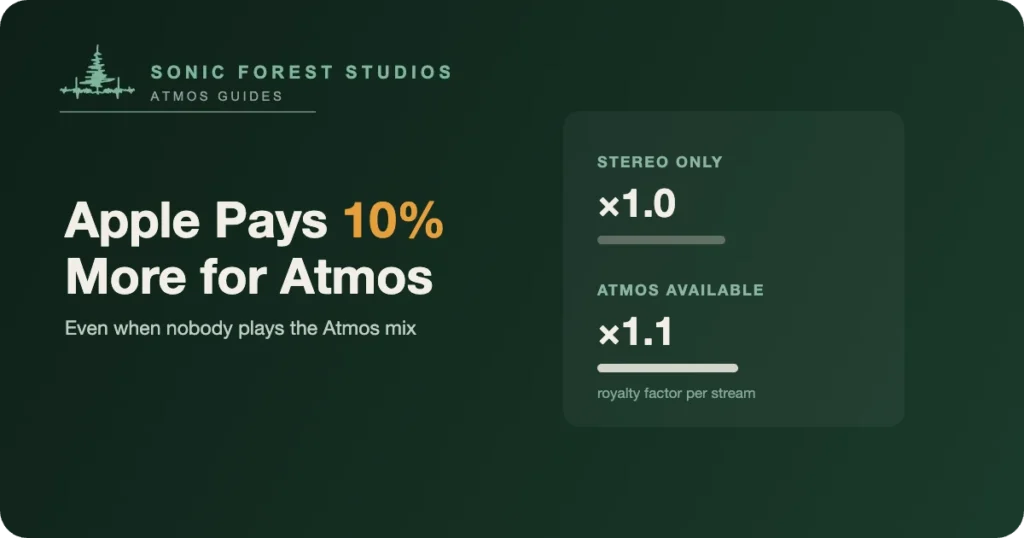
Apple Music pays up to 10% more for a track that’s available in Dolby Atmos, and nobody has to play the Atmos version for you to earn it. That’s the piece about dolby atmos royalties that catches most artists off guard. The uplift is tied to availability, not to listens. If your song sits in the catalogue with an Atmos mix attached, every stream counts at a factor of 1.1 instead of 1.0, whether it came off a HomePod or a beaten-up pair of earbuds on the bus.
So “is Atmos worth doing” stops being a philosophical question and turns into arithmetic. I’ll do the arithmetic first. Then I’ll get into the part nobody really publishes, which is how placement works once the file is actually up there.
The royalty math, without the hand-waving
Apple started applying the higher rate with January 2024 month-end payments. The mechanism is simple. Pro-rata shares for Spatial-available plays get multiplied by 1.1, and everything else stays at 1. Apple’s own framing was that it wanted to reward the time and money artists put into mixing in Spatial, which is a rare case of a platform saying the quiet part out loud. You can read the original announcement coverage here.
Run it against real numbers. Apple’s per-stream rate has been sitting somewhere around $0.008 to $0.010 through 2025 and into 2026, so call it a penny to keep the mental math clean. At 100,000 Apple streams a year, the uplift is worth roughly $80 to $100. At a million, it’s $800 to $1,000. That won’t pay for a mix on its own at the low end. At the high end, and across a catalogue rather than a single, it starts looking like a line item instead of a rounding error.
Here’s the bit I’d underline. The uplift applies to all of that song’s Apple streams, not just the Atmos ones. You’re not being paid for Atmos listening. You’re being paid for Atmos existing.
Available means delivered, not played
This trips people up constantly, so it’s worth being precise. Availability is a catalogue state. Your distributor delivers an ADM BWF alongside the stereo master, Apple ingests it, the track gets flagged, and from that moment every stream on it carries the 1.1 factor. Someone listening on a laptop with the built-in speakers, no spatial-capable device in sight, still counts.
Which means the failure mode isn’t listener behaviour. It’s delivery. If the Atmos file gets rejected at ingest you get nothing, and you often don’t find out quickly. I’ve written separately about what Apple actually rejects and why, and about the five things that most often fail QC. Both of those matter more to your royalty cheque than any creative decision you’ll make in the mix.
Placement is the bigger prize, and it’s less predictable
The 10% is the part you can forecast. Playlisting is the part you can’t, and it’s worth more.
Apple runs dedicated Spatial surfaces, the Made for Spatial Audio playlist being the obvious one, and Spatial plays on editorial playlists have grown enormously since launch. Apple has put that growth north of 250% in monthly Spatial plays on editorial playlists. Editorial placement is still the single biggest lever for instant scale on that platform.
Now, I want to be careful here, because there’s a lot of confident nonsense written about this. Nobody outside Apple can tell you there’s an algorithmic ranking boost for Atmos tracks, and I’m not going to pretend otherwise. What’s observable is narrower and still useful. There are editorial playlists that only Atmos tracks are eligible for. If you haven’t delivered an Atmos mix you’re simply not in the pool. That’s not a boost, it’s eligibility, and eligibility is the part you control.
Amazon’s side gets discussed less. Spatial Audio now comes with Amazon Music Unlimited and the Standard plan, so it isn’t gated behind a premium audio tier the way it was early on, and Amazon has pushed its Atmos catalogue hard since 2023. Smaller audience than Apple. Also less competition for the slots, which cuts both ways.
Why labels care more than artists do
I get asked fairly often why labels push Atmos when a lot of individual artists are lukewarm on it. It’s a portfolio thing. A 10% uplift on one single is noise. A 10% uplift across ten thousand tracks, permanently, is a real revenue line that costs a one-time mixing spend to unlock. Catalogue owners are running that math constantly, and it’s a big part of why so much of the Atmos work happening right now is back catalogue rather than new releases.
If you own your masters, you’re the label. Same math, smaller catalogue.
What I’d actually tell you to do
If you’re putting out a single and nothing else, the royalty uplift on its own probably won’t justify the mix. Do it because the record deserves it, or don’t do it.
If you’re releasing an album, or you’re sitting on a catalogue that still earns, the arithmetic changes. The mix is a one-time cost and the uplift doesn’t expire. The eligibility argument stands on its own too. You can’t get placed on a Spatial playlist with a stereo file.
What I’d avoid is treating an Atmos mix as a checkbox. A careless Atmos mix that passes QC earns the same 10% as a careful one, that’s true. But it’s also the version a playlist editor hears, and it’s the version that follows the record around for the rest of its life. That’s where spatial audio mixing stops being a delivery format and goes back to being a creative decision.
Frequently asked questions
Does Apple Music pay more for Dolby Atmos?
Yes. Apple applies a factor of 1.1 to pro-rata shares for tracks available in Spatial Audio, against 1.0 for everything else, which works out to up to 10% more. It started with January 2024 month-end payments and it’s still running.
Do listeners have to play the Atmos version for me to earn the uplift?
No, and this is the part most artists get wrong. The uplift is tied to the track being available in Spatial Audio, not to anyone choosing it. A stream from a laptop speaker counts the same as one from a HomePod.
How much is the Dolby Atmos royalty uplift actually worth?
At roughly a cent per stream, 100,000 Apple streams a year earns you somewhere around $80 to $100 extra. A million streams gets you $800 to $1,000. On a single that’s thin. Across a catalogue it adds up, and it doesn’t expire.
Does Amazon Music pay a spatial audio bonus?
Amazon hasn’t published a royalty multiplier the way Apple has. What it does offer is reach: Spatial Audio is included with both Unlimited and Standard plans now, so it isn’t locked behind a premium audio tier, and Amazon runs its own Atmos programming with less competition for the slots.
Will an Atmos mix get me on more playlists?
Nobody outside Apple can promise you a ranking boost, and I’d be sceptical of anyone who does. What’s true and checkable is that some editorial playlists only accept Atmos tracks. Without a mix you aren’t eligible, and eligibility is the part you control.
Is it worth mixing older releases in Atmos?
Often yes, if the catalogue still earns. The mix is a one-time cost and the uplift applies to every future stream of that track. That’s why a lot of the Atmos work happening right now is back catalogue rather than new singles.
Todd Hooge is the founder of Sonic Forest Studios, the first Dolby Atmos facility on Vancouver Island. He mixes music and film in Atmos from a 7.1.4 room outside Victoria BC, with more than 454 million streams across his Atmos work.